Posts

Differentiating between Financial Wealth and Real Wealth

Image
 This theme of differentiating between financial and real wealth seems omnipresent and economists often distinguish between the two. The chart below compares the personal savings rate and equity market cap. The personal savings rate is represented as a percentage of disposable income for the US economy and the equity market cap is represented by S & P 500 closing each year.  As S & P  500 market cap keeps climbing since the 1970s the personal savings rate keeps dropping. This behavioral aspect of a typical US investor is more or less true of investors anywhere in the world. The 'wealth effect' of increased market cap seems to have a large impact on investor behavior amongst  other things.  Remember that when every equity investor chooses to cash in the equity market falls in a heap. In the best interest of investors, specially the small investors it would be prudent to convert some part of financial wealth in to real wealth by diversifying into other ass...

Role played by media in a Democracy

Yellow journalism is a style of newspaper reporting that emphasized sensationalism over facts . ... Once the term had been coined, it extended to the sensationalist style employed by publishers in their profit-driven coverage of world events.....(google search)  The role played by media in a democracy cannot be understated and with greater proliferation of online platforms - the impact of media is only going to grow further. At the end of the day media houses need to pay their bills and salaries to employees. So some 'entertainment' stuff is acceptable but media can help better by focusing on the following areas: 1. Status and progress of key infrastructure projects by state or region. Details on financials and cost overruns, time delays etc. Governments are spending thousands of crores on infra projects and common people may not have the time and inclination to look for these details. 2. Last mile delivery issues - last mile delivery needs continuous monitoring - it does n...

Perspectives on India's Telecom Industry

Image
Introduction As of 2021, India has 82.53 crores internet users second only to China which has close to 99 crores subscribers. And yet, it represents only 61% of India's population ( wiki )- which underlines the growth potential of India's telecom industry. Developed countries like the United States have an internet usage rate of 95.5% of the total population. As per TRAI's press release of 30th June 2021, there are a total of 1202.56 million subscriptions in India and the breakup is shown below:           The chart below shows that the proportion of wire-line subscriptions has been moderating over the years. In terms of tele-density which measures the number of subscriptions for every hundred individuals living in an area the total density for India as of June 30 2021 as per TRAI is 88.07%. Again the more interesting aspect to note is that Urban India has a tele-density of 140.86% whereas rural India has a tele-density of 60.10%. So the poten...

The Great Depression: 1929 to 1933

Image
The Great Depression of 1929 to 1933 is a landmark event in the economic history of the world. Till date many organizations use the stress scenarios of this event in building their economic models.  Let us examine the causes and effects of the Great Depression of 1929.  Causes of the Great Depression: A decline in the aggregate demand led to the Great Depression of 1929. A general loss of business confidence, stock market crash, gold standard, misplaced fiscal and monetary polices are cited as some of the reasons for the Great Depression.  Some the prominent causes are discussed below. 1. The Stock Market Crash 1929:  The Great Depression is a classic example of a correction in financial economy impacting the real economic activity. The stock market crash of Black Thursday, Oct 24, 1929 also called as the Great Crash caused a dent in the general business sentiment. This in turn led to decline in investment spending. The 'roaring twenties' during which many investors...

Olympic Glory and Economic Development

Image
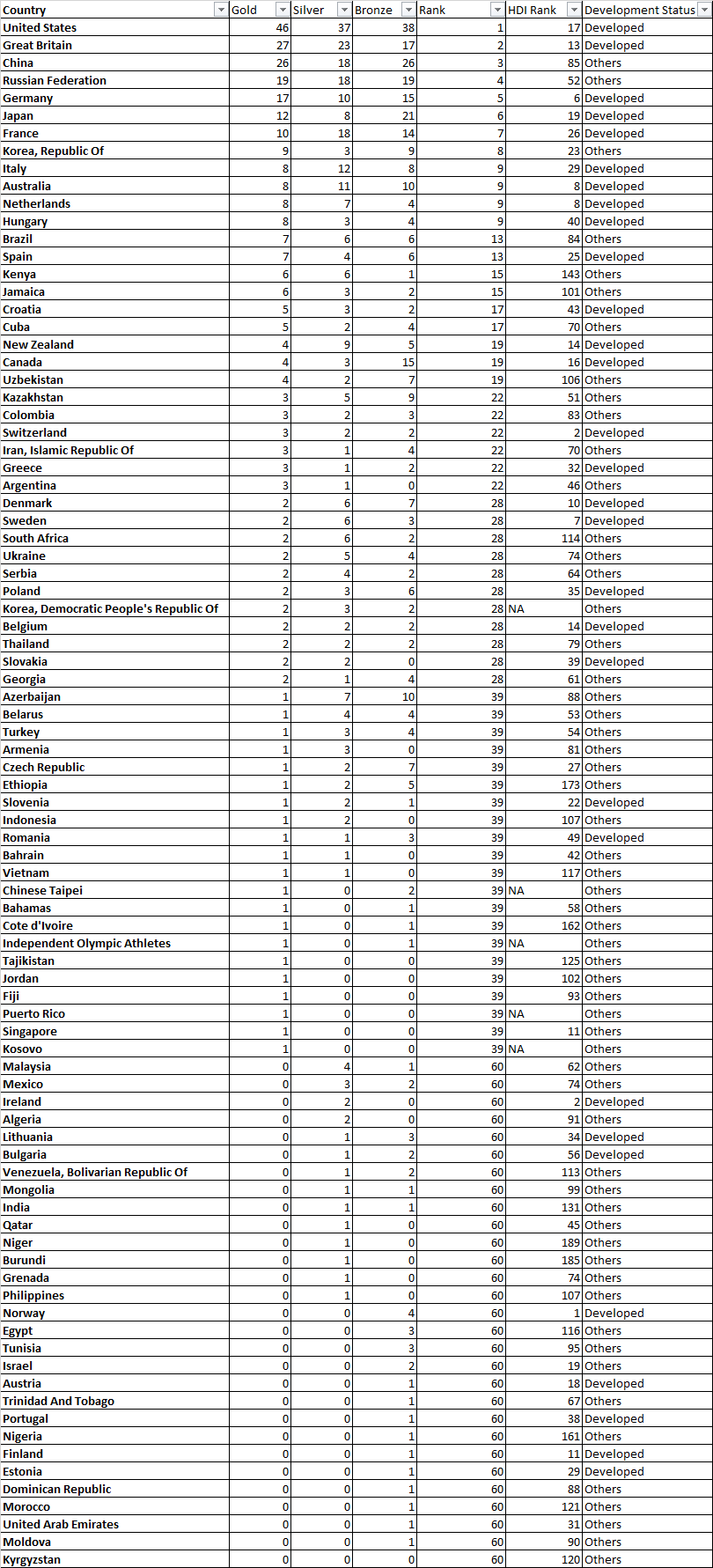
The Olympics are here, this time in Tokyo and athletes from all around the world have come together to claim their share of Olympic glory. The table below lists the countries with their medal tally from the Rio Olympics 2016 along with development status and Human Development Index rank. In the table above, we can observe that except for Russian Federation, China and Korea, all the top performing countries are developed countries. To be fair, China and South Korea are already on the path to development.  If people are struggling to meet their day to day expenditures they would not be able to invest time in sports or research or arts. Although a crude and imperfect measure, the performance of a country in Olympics reflects the economic development and prosperity of that country.  If a country is performing at regional sports meets and fails at global sports then it implies the region is undeveloped and the country has a long way to go. Privatize Sports Administration Sports m...

Key Economic and Welfare Indicators for Global Economies

Image
GDP, Per Capita GDP, GDP growth rates etc may not always capture the welfare and standard of living of the people. GDP growth is dependent on a number of factors including global economic environment and natural calamities which are well beyond the control of any one country or group. Even in the "rich" economies of the west, economic inequality is surprisingly high. In case of emerging market economies with high populations this contrast is even starker. The scope for re-distributive taxes is limited in case of emerging markets, they would not want to hurt their growth prospects. For low and middle income group countries the transition to high income group may last several decades and growth (and development) may remain "top heavy" for a long time to come. As such these low or middle income economies will have to make the best of what they have by focusing on administrative/governance procedures and outcomes. The target must be to provide at least a minimum sta...

The Trade-Off Between Equality and Efficiency

Image
Reference: Chapter - 17 Economics by Nordhaus and Samuelson  The debate between equality and efficiency is not new and no economy in this world is immune to this trade-off. Let us examine the main propositions in this debate: Proposition 1: The Theme of Welfare Economics is Universally Accepted In an ideal scenario, markets should be able to balance between equality and efficiency and governments do not have to interfere with market mechanisms but in reality, capitalist economies are like jungles, only those who are fit enough can survive. So it is widely accepted that the responsibility of the welfare of the poor and ill-equipped falls on the governments of the day. Governments across the world undertake several welfare schemes including social security, health care, pensions for the elderly and unemployed, insurance, women and child welfare, cash transfers, income - support etc. Proposition 2: The Bucket is Leaky Consider the figure above in which real incomes of the upper half a...